
Czas Na Piłkę / Blog / Training and injuries
Pickup game with friends or coached training? Five reasons adult amateurs benefit from a coach
Playing without structure means more injuries, less progress and giving up more easily. We look at what research says about warming up and why a coach makes the difference.
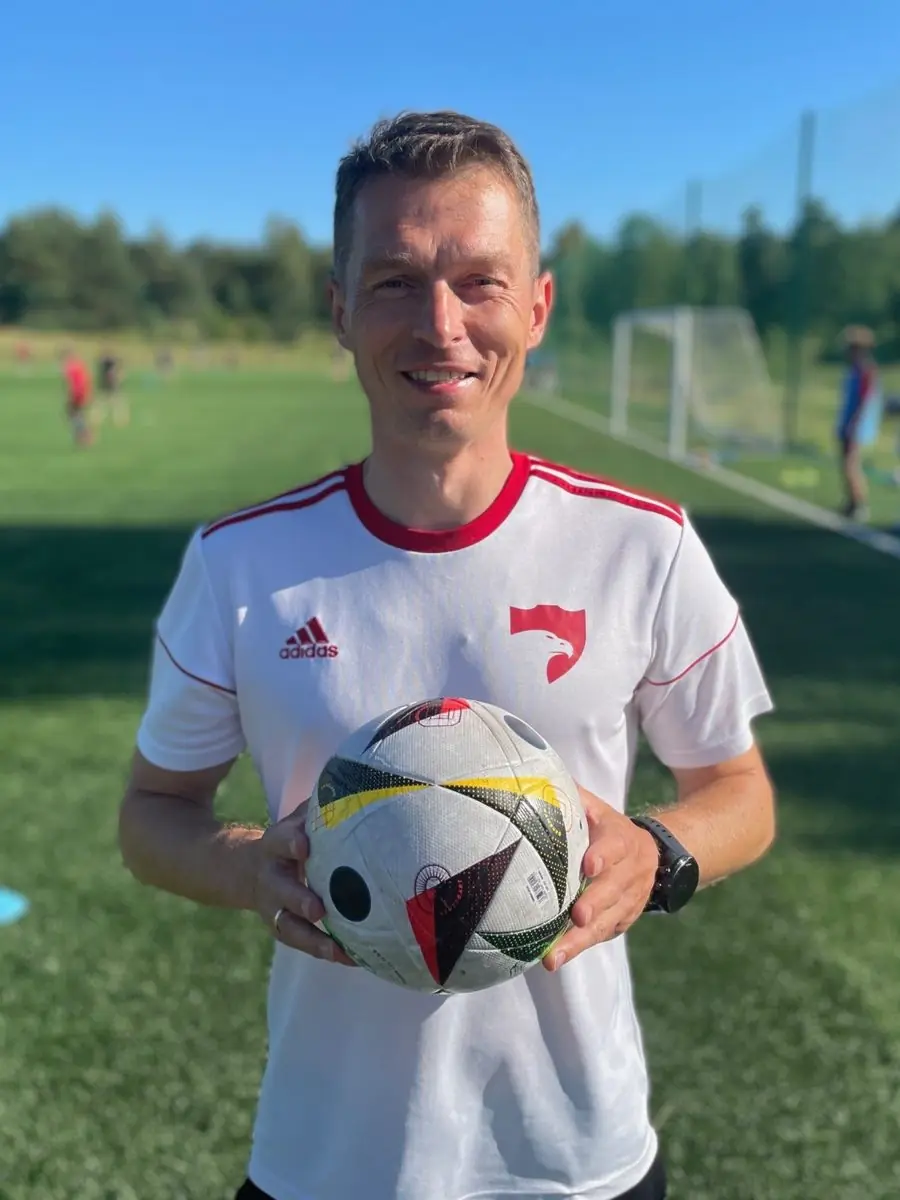 Tomasz OpanowskiUEFA B coach · 5 min read
A pickup game with friends at the local pitch is free, training costs money. Why pay? It is a fair question and it deserves a fair answer. Playing on your own terms has its charm, but it also has costs you don't see straight away: injuries, no progress and how easy it is to drop out.
In short
“Let's just play a game”: why this is where most injuries happen
You know the drill: you arrive straight from work, a couple of leg swings and you're playing. The first sprint for the ball, a twinge in the back of your thigh and the evening is over. Then a few weeks off.
Cold muscles and tendons cope badly with sudden acceleration, braking and turning. And in football that's the basics. Add tiredness after work and the fact that at a pickup game nobody keeps an eye on how much and how hard you play.
Injury prevention is a specific programme, not just talk
FIFA 11+ is a warm-up developed by FIFA's medical experts. It consists of running, strength, plyometric and balance exercises. Its effectiveness has been tested in controlled studies.
A 2017 meta-analysis by Sadigursky and colleagues covered 6 studies and 6,344 players. Result: injury risk lower by an average of 30%. A review of studies in amateur teams showed 30 to 70% fewer injured players.
The most interesting study involved amateurs. Al Attar and colleagues (2017) followed 344 players aged 14-35. Teams that did the programme before and after training had 26 injuries. Teams that did it only before had 82.
Al Attar W.S.A. et al., J Physiother 2017.
A 2025 review of studies (Cureus) puts the effect at 30-46% and stresses two conditions: regularity and correct technique. And that is the crux. A programme you found online won't do anything if you do it once a month, half-heartedly. A warm-up led by a coach takes care of both conditions.
Strength of evidence
- Strong FIFA 11+ reduces injury risk by about 30% (meta-analysis of 6 controlled studies).
- Moderate Programme before and after training in amateurs: 26 vs 82 injuries (one study, 344 people).
- Weak or indirect Most studies involve younger players. For 40-year-olds this is a reasonable extrapolation, not direct evidence.
Research shows associations, but it doesn't replace seeing a doctor. If you have high blood pressure, diabetes or a heart condition, get checked before you return to playing.
Technique and tactics after 30: can you still learn?
You can. You won't turn pro, but a better first touch, a more accurate pass and knowing where to stand come from repetition and feedback. At a pickup game there is no feedback and the repetition is random.
In training you practise a specific skill and then test it in a game. The coach sees what you do well and what you could change with a single adjustment. Adults often learn faster than children, because they understand why they are doing an exercise.
A plan and progress: why structure helps you stick with it
When you play without a plan, every evening looks the same. In training you see progress: you catch your breath more easily, you get back to defend faster, you ache less the next day. Progress is the best motivation to come back next week.
A group, a fixed time, a coach: motivation that doesn't depend on your mood
You go to a pickup game if someone gets a team together and if you feel like it. You go to training because it's Tuesday, the group is waiting for you and the coach has a plan. A fixed slot takes the decision out of your hands. And the “do I feel like it today” decision is the biggest enemy of consistency.
Coach's tip
A warm-up isn't time taken away from playing. It is insurance that lets you play next week. I always ask newcomers: would you rather do 15 minutes of warm-up or take 6 weeks off with a torn muscle?
What a session looks like at Czas Na Piłkę
A session lasts 90-105 minutes. First the warm-up and the main part, about 40 minutes, then about 60 minutes of football. The plan is built on five fixed blocks: strength, sport-specific endurance, technique, tactics and injury prevention.
Every session is led by a UEFA-licensed coach. There are no trials and we don't assess your skills. How to prevent injuries off the pitch is covered in Warm-up, injuries, recovery.
Injury prevention is a fixed block in our sessions
Every session is led by a UEFA-licensed coach, and injury prevention is one of the five fixed blocks of the plan.
About the author
Tomasz Opanowski
Football coach with a UEFA B licence, on the pitch since 2007. Founder of the Młody Orlik football academy and coach at Czas Na Piłkę, where since 2018 he has been bringing adults who once hung up their boots back into the game. He writes about how to return to football after years away: sensibly, without injuries and with plenty of fun.
Play more, heal less
A warm-up and injury prevention in every session. UEFA-licensed coaches.