
Czas Na Piłkę / Blog / Health and science
Your mid-twenties. Why regular football now is the best investment for the next 20 years
The biggest value of football for a 25-year-old is keeping your fitness and your exercise habit before work and responsibilities push them out. Plus a reset from stress and friends in a new city.
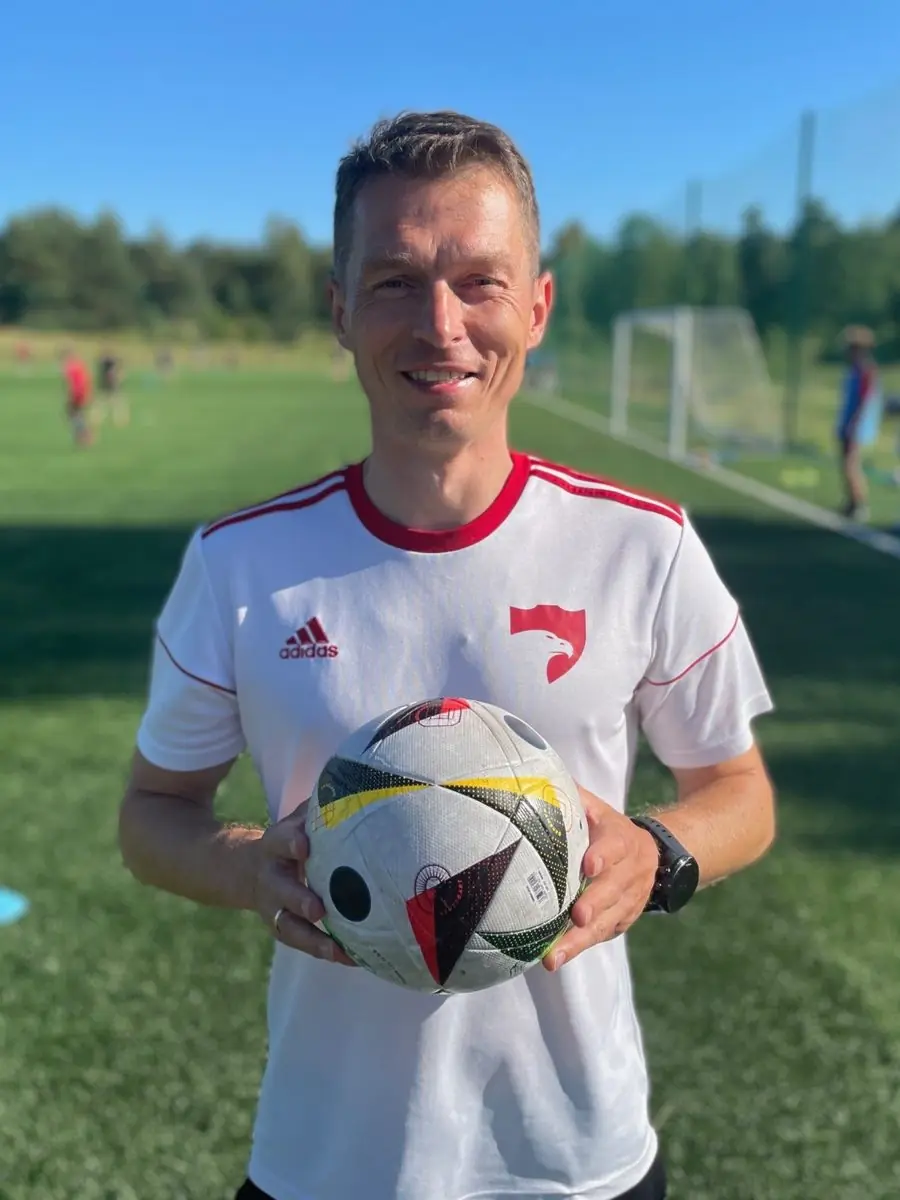 Tomasz OpanowskiUEFA B coach · 5 min read
You are 25, nothing hurts, and you join a game with friends at the local pitch whenever someone gets a team together. Why train regularly? Because how you will feel after 40 is something you are building right now. The companion article for older players: Football after 40.
In short
The end of school and youth football: the moment most people stop playing
Most of us played football at school, in the street, sometimes at a youth club. Then come university, the first job, a move. The team breaks up and playing becomes occasional.
The data confirm this drop. In the 2022 Eurobarometer, 42% of people aged 25-39 exercised regularly, and only 32% of those aged 40-54. A habit you don't keep now will be harder to rebuild in 15 years.
Fitness is capital: VO2max and what 13% in 12 weeks means
VO2max measures how much oxygen your body can use during exercise. Put simply: how good your “engine” is. It naturally declines with age, and regular exercise slows that decline.
In a 2009 Danish study, untrained men aged 20 and up improved their VO2max by 13% after 12 weeks of playing 2-3 times a week. So the findings apply to your age group too. More about that study in Football is Medicine.
Figures compiled by Professor Krustrup (“Science and Football VIII”, 2017) show how much happens in a single hour of football. In a 2010 study by Randers and colleagues, heart rate in small-sided games reached 162 beats per minute, and players spent 16-17% of the time above 90% of their maximum heart rate. That is the intensity of interval training.
Desk, screen, stress: football as a reset after work
Eight hours in front of a screen, then your phone on the way home. Football forces something scrolling never gives you: full focus on the here and now. For an hour and a half you don't think about emails, because you have to think about the ball.
A 2024 meta-analysis by Noetel and colleagues (BMJ, 218 studies) showed that exercise effectively helps people with symptoms of depression. Football wasn't a separate category there, but the mechanism is shared: effort, rhythm and contact with people. We write more about this in The mind plays too.
Strength, speed, power: what you develop in small-sided games
In small-sided games everyone is closer to the ball. More touches, more duels, more sprints. It is training in accelerating, braking and changing direction, the qualities that protect you from injury in everyday life and make the difference in sport. And technique: the more touches of the ball, the faster you improve.
What to watch out for at 25: overload, ambition outrunning fitness, no warm-up
At this age your head tells you that you can do anything. Your body often keeps up too, until it doesn't. The typical scenario: a month off, then three full-on games in a week. Your hamstrings and groin don't like that.
The second trap is going straight into a game without a warm-up. The FIFA 11+ warm-up programme reduces injury risk by an average of 30%. We cover it in Warm-up, injuries, recovery.
Coach's tip
You have fitness in reserve, so use it wisely: two sessions a week all year will give you more than five games in May and a break until September. Consistency beats intensity.
A team instead of a lonely gym
You go to the gym on your own and decide on your own whether you feel like it today. A training session comes with a group, a fixed time and a coach waiting for you. That is a completely different kind of motivation.
New city, new job? A team is also the easiest way to meet people. After training we have our internal league Czas Na Ligę and trips, and people often leave the pitch with friends for years. Our coaches speak English, so you can join even if your Polish is still a work in progress.
Play at the local pitch now and then?
Try playing regularly, with a plan and a coach. The first step is one form and one evening.
About the author
Tomasz Opanowski
Football coach with a UEFA B licence, on the pitch since 2007. Founder of the Młody Orlik football academy and coach at Czas Na Piłkę, where since 2018 he has been bringing adults who once hung up their boots back into the game. He writes about how to return to football after years away: sensibly, without injuries and with plenty of fun.
Start while the habit is easy
A regular group, a fixed time and a coach. In the evenings, all year round.