
Czas Na Piłkę / Blog / Trivia
How far do you run and how much do you burn? Football numbers from the World Cup to a Wednesday session
A pro runs about 10-11 km in a match, and an amateur in an hour-long small-sided game works at an intensity close to an elite match. Numbers, comparisons and a calorie calculator.
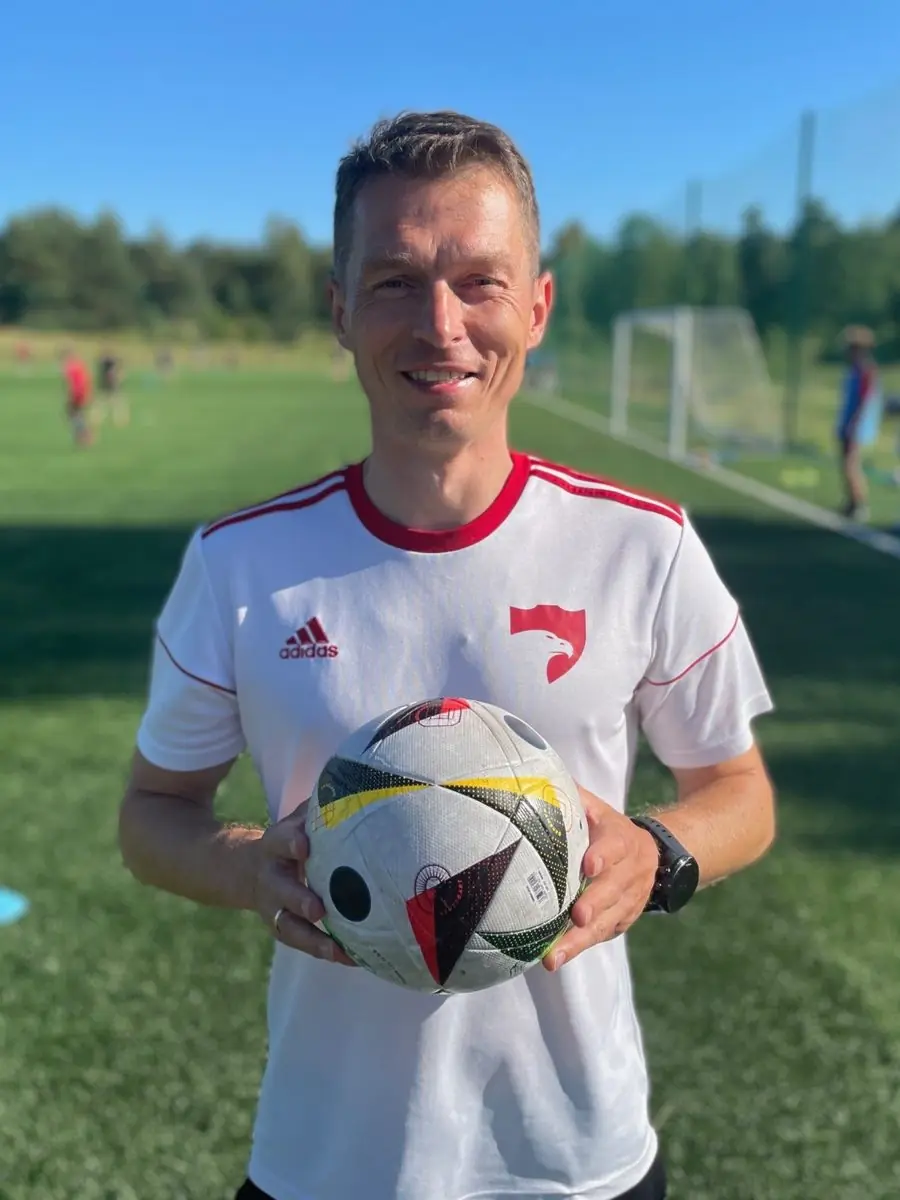 Tomasz OpanowskiUEFA B coach · 5 min read
Like numbers? This article is lighter than the others. We compare World Cup pros with amateurs playing after work. The result may surprise you: in an hour-long small-sided game you work at an intensity close to an elite match.
In short
How many people play football worldwide and in Poland
FIFA's last full count, the Big Count from 2006, found 265 million players worldwide, including 38 million registered. The data are old, but there is no newer full census.
There are surprisingly few professionals. According to a 2023 FIFA report, there are 128,694 professional footballers in the world. The vast majority of players are amateurs, like you. In Poland, according to the Polish Football Association (PZPN, May 2026), there are about 400,000 registered players, which according to the association's secretary general is still well below the European average.
The World Cup in numbers: how far the pros run
At the 2022 World Cup, a team covered an average of 108.1 km per match. Divided by ten outfield players, that is about 10.8 km per player. This is our simplification, because the goalkeeper runs too, and midfielders usually run more than defenders. Some midfielders went over 13 km.
On a full-size pitch in an 11-a-side match, though, a lot of the time is jogging and positioning. In a small-sided game there are far fewer of those breaks.
And you, on Wednesday at 20:00? Heart rate, sprints and turns in a small-sided game
In studies by Randers and colleagues (2010 and 2014), amateurs playing small-sided games worked at about 83-85% of their maximum heart rate. Interestingly, regardless of whether they played 3 v 3, 5 v 5 or 7 v 7. And in Professor Krustrup's figures, an hour of 7-a-side is 886 changes of movement, including 98 high-intensity runs and 16 sprints.
Krustrup P., “Science and Football VIII”, Routledge 2017.
How many calories an hour of football burns (and how to work it out for yourself)
Scientists describe effort in MET units. According to the 2024 Compendium of Physical Activities, recreational football is 7.0 MET and competitive play 9.5 MET. The formula is simple: kcal ≈ MET × body weight in kg × time in hours.
For a person weighing 80 kg, an hour of recreational football is about 560 kcal, and competitive play about 760 kcal. Work it out for yourself:
How much do you burn in a session?
Casual game, 60 min, 80 kg.
Formula: kcal ≈ MET × body weight (kg) × time (h). MET values from the Compendium of Physical Activities 2024.
Why kilometres aren't everything
After a session your watch might show 5-6 km. That's less than a pro, but it doesn't mean you worked less. What counts are the accelerations, braking, turns and duels. Each of those moments costs a lot of energy, and your watch sees it as just a few metres.
That is why studies look at heart rate and the number of high-intensity actions rather than just kilometres. More on what that does for your health in Football is Medicine.
Coach's tip
Bring a sports watch to training and compare your heart rate in the same game after a month. When your heart beats more slowly for the same effort, you know your fitness is improving. It is a better measure than the scales.
Find out how far you run
Bring your watch to your first session. Evening groups all year round, indoors in winter.
About the author
Tomasz Opanowski
Football coach with a UEFA B licence, on the pitch since 2007. Founder of the Młody Orlik football academy and coach at Czas Na Piłkę, where since 2018 he has been bringing adults who once hung up their boots back into the game. He writes about how to return to football after years away: sensibly, without injuries and with plenty of fun.
Your numbers start with your first session
Bring a watch and see how far you run in a small-sided game. No trials, in the evenings.